Amazons
Alternative Names (異名):
Amazons, Ἀμαζόνες, Amazónes
The Amazons (Greek: Ἀμαζόνες, Amazónes, singular Ἀμαζών, Amazōn) are a nation of all-female warriors in Classical and Greek mythology. Herodotus placed them in a region bordering Scythia in Sarmatia (modern territory of Ukraine). Other historiographers place them in Asia Minor or Libya.
Notable queens of the Amazons are Penthesilea, who participated in the Trojan War, and her sister Hippolyta, whose magical girdle was the object of one of the labours of Hercules. Amazonian raiders were often depicted in battle with Greek warriors in amazonomachies in classical art.
The Amazons become associated with various historical peoples throughout the Roman Empire period and Late Antiquity. In Roman historiography, there are various accounts of Amazon raids in Asia Minor. From the Early Modern period, their name has become a term for woman warriors in general.
Worrior | Amazons |
Wednesday, November 25, 2009

Saturday, July 25, 2009
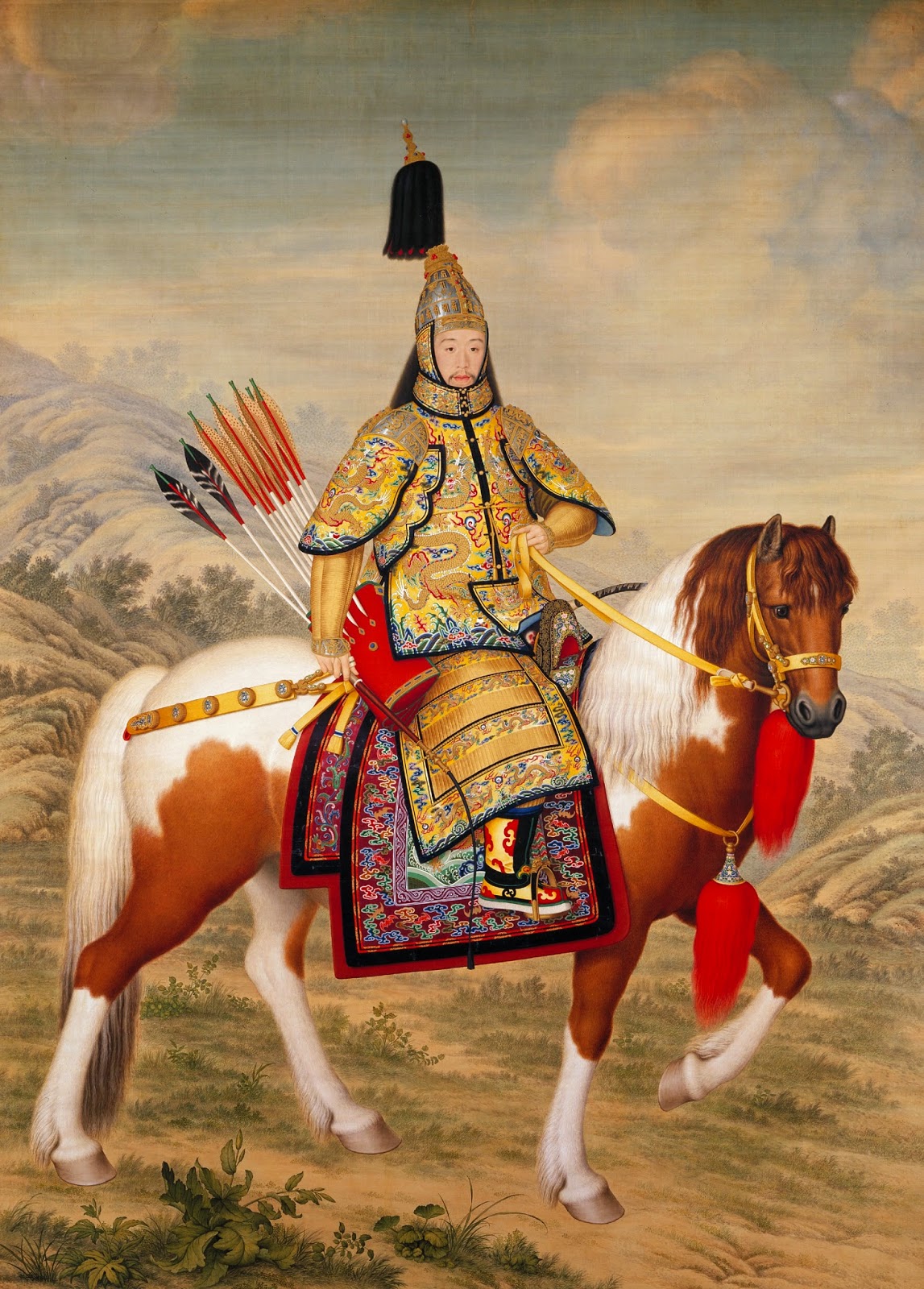
The Qianlong Emperor in Ceremonial Armour on Horseback
The Qianlong Emperor in Ceremonial Armour on Horseback
From Wikimedia Commons http://commons.wikimedia.org/
From http://joeungul1.blogspot.com/
| Description | The Qianlong Emperor in Ceremonial Armour on Horseback |
| Artist | Giuseppe Castiglione (1688–1766) |
| Date | 1758 |
| Medium | ink and color on silk |
| Dimensions | Height: 322.5 cm (127 in). Width: 232 cm (91.3 in). |
| Current location | Palace Museum |
| References | Pamela Kyle Crossley (1999) A Translucent Mirror: History and Identity in Qing Imperial Ideology, University of California Press, pp. 272-276 ISBN: 9780520234246. |
| Source/Photographer | MondoMostre |
| Licensing | This work is in the public domain in the United States, and those countries with a copyright term of life of the author plus 100 years or less. |
From Wikimedia Commons http://commons.wikimedia.org/
From http://joeungul1.blogspot.com/
Thursday, April 30, 2009
Japanes clothes
Japanes clothes

From Wikimedia Commons

| Description | 日本語: 佐賀県嬉野温泉にある江戸時代の長崎街道を再現したテーマパーク【肥前夢街道】 English: Hizen Yume Kaido, a historical theme park which reproduces Ureshino Town during the Edo Period. |
| Date | 29 April 2009 |
| Source | 嬉野温泉 肥前夢街道 |
| Author | shinya kawano |
| Licensing | The copyright holder of this work releases this work into the public domain. This applies worldwide. |
From Wikimedia Commons
Friday, January 9, 2009
Finance, Nicolas Sarkozy

- Nicolas Sarkozy, French President, At the Symposium "New World, New Capitalism," Paris, Jan. 9, 2009
Monday, March 31, 2008
Ariadne (Greek)
Ariadne
Alternative Names (異名):
Ariadne
Ariadne, in Greek mythology, was daughter of King Minos of Crete and his queen, Pasiphaë, daughter of Helios, the Sun-titan. She aided Theseus in overcoming the Minotaur and later became the consort of the god, Dionysus.
Alternative Names (異名):
Ariadne
Ariadne, in Greek mythology, was daughter of King Minos of Crete and his queen, Pasiphaë, daughter of Helios, the Sun-titan. She aided Theseus in overcoming the Minotaur and later became the consort of the god, Dionysus.
Thursday, February 14, 2008
Andromeda (Greek)
Andromeda
Alternative Names (異名):
Andromeda, Ανδρομέδη, Andromedē, 안드로메다
Andromeda was a woman from Greek mythology who was chained to a rock to be a sacrifice to a sea monster as divine punishment for her mother's bragging. She was saved from death by Perseus, her future husband. Her name is the Latinized form of the Greek Ανδρομέδη (Andromedē). The etymology of the name is "to think of a man," from ανδρος (andros) "man" combined with μηδομαι (mēdomai) "to think, to be mindful of."
Myth
In Greek mythology, Andromeda was the daughter of Cepheus and Cassiopeia, king and queen of the Phoenician kingdom Ethiopia.
Her mother Cassiopeia bragged that she was more beautiful than the Nereids, the nymph-daughters of the sea god Nereus and often seen accompanying Poseidon. To punish the Queen for her arrogance, Poseidon, brother to Zeus and God of the Sea, sent a sea monster, Cetus, to ravage the coast of Ethiopia and the kingdom of the vain Queen. The desperate King consulted the Ammon, the Oracle of Zeus, who announced that no respite would be found until the king sacrificed his virgin daughter Andromeda to the monster. She was duly chained to a rock on the coast.
Perseus, returning from having slain the Gorgon Medusa, found Andromeda and slew the monster Cetus. He set her free, and married her in spite of Andromeda having been previously promised to Phineus. At the wedding a quarrel took place between the rivals, and Phineus was turned to stone by the sight of the Gorgon's head (Ovid, Metamorphoses v. 1).
Andromeda followed her husband to Tiryns in Argos, and together they became the ancestors of the family of the Perseidae through the line of their son Perses. Perseus and Andromeda had six sons Perseides, Perses, Alcaeus, Heleus, Mestor, Sthenelus, and Electryon, and one daughter, Gorgophone. Their descendants ruled Mycenae from Electryon down to Eurystheus, after whom Atreus attained the kingdom, and would also include the great hero Heracles. According to this mythology, Perses is the ancestor of the Persians.
After her death she was placed by Athena amongst the constellations in the northern sky, near Perseus and Cassiopeia. Sophocles and Euripides (and in more modern times Corneille) made the story the subject of tragedies. The tale is represented in numerous ancient works of art.
Constellations
Andromeda is represented in the northern sky by the constellation Andromeda which contains the Andromeda Galaxy.
Four constellations are associated with the myth. Viewing the fainter stars, visible to the naked eye, the constellations are rendered as:
A large man wearing a crown, upside down with respect to the ecliptic. (The constellation Cepheus)
A smaller figure, next to the man, sitting on a chair. As it is near the pole star, it can be seen the whole year, although sometimes upside down. (The constellation Cassiopeia)
A maiden, chained up, facing/turning away from the ecliptic. (The constellation Andromeda), next to Pegasus.
A sea monster just under the ecliptic. (The constellation Cetus)
The king of Ethiopia Cepheus and the Cassiopeia queen thank Perseus for freeing their daughter Andromeda, La Délivrance d'Andromède (1679) Pierre Mignard, Louvre.Other constellations related to the story are:
Perseus
The constellation Pegasus, who was born from the stump of Medusa's neck, after Perseus had decapitated her.
The constellation Pisces, which may have been treated as two fish caught by Dictys the fisherman who was brother of Polydectes king of Seriphos where Perseus and his mother Danaë were stranded.
Reference
Apollodorus, Bibliotheke II, iv, 3-5.
Ovid, Metamorphoses IV, 668-764.
Edith Hamilton, Mythology, Part Three, 204-207.
Links
http://en.wikipedia.org/wiki/Portal:Mythology
Alternative Names (異名):
Andromeda, Ανδρομέδη, Andromedē, 안드로메다
Andromeda was a woman from Greek mythology who was chained to a rock to be a sacrifice to a sea monster as divine punishment for her mother's bragging. She was saved from death by Perseus, her future husband. Her name is the Latinized form of the Greek Ανδρομέδη (Andromedē). The etymology of the name is "to think of a man," from ανδρος (andros) "man" combined with μηδομαι (mēdomai) "to think, to be mindful of."
Myth
In Greek mythology, Andromeda was the daughter of Cepheus and Cassiopeia, king and queen of the Phoenician kingdom Ethiopia.
Her mother Cassiopeia bragged that she was more beautiful than the Nereids, the nymph-daughters of the sea god Nereus and often seen accompanying Poseidon. To punish the Queen for her arrogance, Poseidon, brother to Zeus and God of the Sea, sent a sea monster, Cetus, to ravage the coast of Ethiopia and the kingdom of the vain Queen. The desperate King consulted the Ammon, the Oracle of Zeus, who announced that no respite would be found until the king sacrificed his virgin daughter Andromeda to the monster. She was duly chained to a rock on the coast.
Perseus, returning from having slain the Gorgon Medusa, found Andromeda and slew the monster Cetus. He set her free, and married her in spite of Andromeda having been previously promised to Phineus. At the wedding a quarrel took place between the rivals, and Phineus was turned to stone by the sight of the Gorgon's head (Ovid, Metamorphoses v. 1).
Andromeda followed her husband to Tiryns in Argos, and together they became the ancestors of the family of the Perseidae through the line of their son Perses. Perseus and Andromeda had six sons Perseides, Perses, Alcaeus, Heleus, Mestor, Sthenelus, and Electryon, and one daughter, Gorgophone. Their descendants ruled Mycenae from Electryon down to Eurystheus, after whom Atreus attained the kingdom, and would also include the great hero Heracles. According to this mythology, Perses is the ancestor of the Persians.
After her death she was placed by Athena amongst the constellations in the northern sky, near Perseus and Cassiopeia. Sophocles and Euripides (and in more modern times Corneille) made the story the subject of tragedies. The tale is represented in numerous ancient works of art.
Constellations
Andromeda is represented in the northern sky by the constellation Andromeda which contains the Andromeda Galaxy.
Four constellations are associated with the myth. Viewing the fainter stars, visible to the naked eye, the constellations are rendered as:
A large man wearing a crown, upside down with respect to the ecliptic. (The constellation Cepheus)
A smaller figure, next to the man, sitting on a chair. As it is near the pole star, it can be seen the whole year, although sometimes upside down. (The constellation Cassiopeia)
A maiden, chained up, facing/turning away from the ecliptic. (The constellation Andromeda), next to Pegasus.
A sea monster just under the ecliptic. (The constellation Cetus)
The king of Ethiopia Cepheus and the Cassiopeia queen thank Perseus for freeing their daughter Andromeda, La Délivrance d'Andromède (1679) Pierre Mignard, Louvre.Other constellations related to the story are:
Perseus
The constellation Pegasus, who was born from the stump of Medusa's neck, after Perseus had decapitated her.
The constellation Pisces, which may have been treated as two fish caught by Dictys the fisherman who was brother of Polydectes king of Seriphos where Perseus and his mother Danaë were stranded.
Reference
Apollodorus, Bibliotheke II, iv, 3-5.
Ovid, Metamorphoses IV, 668-764.
Edith Hamilton, Mythology, Part Three, 204-207.
Links
http://en.wikipedia.org/wiki/Portal:Mythology
Tuesday, December 18, 2007
Atlas
Atlas
Atlas was the son of Iapetus. Unlike his brothers Prometheus and Epimetheus, Atlas fought with the other Titans supporting Cronus against Zeus. Due to Cronus's advance age Atlas lead the Titan's in battle. As a result he was singled out by Zeus for a special punishment and made to hold up the world on his back.
Atlas was the son of Iapetus. Unlike his brothers Prometheus and Epimetheus, Atlas fought with the other Titans supporting Cronus against Zeus. Due to Cronus's advance age Atlas lead the Titan's in battle. As a result he was singled out by Zeus for a special punishment and made to hold up the world on his back.
Subscribe to:
Posts (Atom)